Showing posts with label Eagle. Show all posts

Tuesday, February 5, 2013

Black Eagle is Tropical Asia Animal


 The Black Eagle (Ictinaetus malayensis) is a bird of prey. Like all eagles, it is in the family Accipitridae, and is the only member of the genus Ictinaetus. They soar over forests in the hills in tropical Asia and hunt mammals and birds, particularly at their nests. They are easily identified by their broad and long stretches primary "fingers", features silhouette, slow flight and yellow ceres and legs that contrast with their dark feathers.

The Black Eagle breed in tropical Asia. Ras perniger (Hodgson, 1836) are found in the Himalayan foothills west through Nepal into northeastern Murree in the Eastern and Western Ghats forest in peninsular India and Sri Lanka. This species also extends into the Aravalli range northwestern India.The malayensis nominate race (Temminck, 1822) found in Burma, southern China (Yunnan, Fujian) and Taiwan, the Malay Peninsula. They are generally people and no migration was observed.

In a study in southern India, was found to support the forest with good forest cover and is absent from the county where the cover is less than 50%.

The Black Eagle is a large raptor at about 70-80 cm. Adults have all-black fur, with yellow bill base (Cere) and feet. Long wings and caught in the deepest advances provide a special form. Tail shows faint barring and upper tail covers paler. When perched the wing tips reach or exceed until the end of the tail. Wings held at V superficial (wing directly above the horizontal field) in flight. Seen on a hot afternoon, explore the tree top to the nest to rob, these birds are easily noticeable with jet black color, large size, and 'features' slow flight, sometimes just above the canopy.

Of the same sex, but young birds have a buff head, hamster and underwing feathers. Wing shape helps to distinguish this species from the dark Crested Hawk-Eagle, (Spizaetus cirrhatus). Fully Tarsi hairy toes and strong short relative to the less powerful long claws curved compared to other birds of prey.

The Black Eagle eating mammals, birds and eggs. This is a nest predator-productive and is known for slow flight over the canopy. Because of this ability to keep an eagle high for a long time with little effort, the people of India Lepcha of Darjeeling District described as a bird that never sat.

Curved claws and gape width allows for taking eggs from nests. Along with the Swallow-tailed Kites they share a unique habit carried off whole nest with nestlings to eat perch. Squirrels, monkeys and a variety of birds emit alarm calls when birds seem surf the forest. The Indian Giant Squirrel has been recorded as prey of this species and young Bonnet monkeys can also be victims.

Courtship display involves steep dive with folded wings to sweep in a U-shape to a vertical stall. They build a nest platform, 3 to 4 feet wide, on tall tree overlooking a steep valley. One or two white eggs blotched in brown and purple can be placed during nesting season between January and April. Nest site could be used again year after year.

Monday, February 4, 2013

Harpy Eagle is Central America Animal


Harpy Eagle (Harpia harpyja), is a Neotropical species of eagle. This is sometimes known as the American Harpy Eagle Eagle to distinguish from Papua who is sometimes known as the New Guinea Harpy Eagle Harpy Eagle or Papua. This is the largest and most powerful raptor found in the Americas, and between species that still have the largest eagle in the world. Usually inhabits tropical rain forests lowland layer (appear) on the canopy. Destruction of its natural habitat has disappeared see from many parts of the former, and almost extirpated in Central America.

The top Harpy Eagle is covered with slate black feathers, and under most of the white, except for feathered tarsi, which are black ribbed. There is a broad black band across the upper breast, gray head separates from the white belly. Pale gray head, and crowned with a double crest. The upperside black tail with three gray bands, while the bottom is black with three white bands. The colored iris gray or brown or red, Cere and black or blackish bill and tarsi and feet are yellow. The hairs of men and women are equal. Tarsus is up to 13 cm (5.1 in) long.

Women Harpy Eagles typically weigh 6 to 9 kg (13 to 20 lb). A very large captive female, "A lot", weighing 12.3 kg (27 lb). Being captive, this large female may not represent weight possible in wild Harpy Eagles due to differences in food availability.

Male, compared, much smaller and weighs only about 4 to 4.8 kg (8.8 to 11 lb). Harpy Eagles is 86.5 to 107 cm (2 ft 10 in-3 ft 6 in) long and has a wingspan of 176 to 224 cm (5 ft 9 in. to 7 ft 4 in). Between measurement standard, wing chord measure 54-63 cm (1 ft 9 in.-2 ft 1 in), the tail measure 37-42 cm (1 ft 3 in-1 ft 5 in), Tarsus is 11.4 to 13 cm (4.5 to 5.1 in.) long and Culmen hit from Cere is 4.2 to 6.5 cm (1.7 to 2.6 in).

This is sometimes referred to as the largest eagle, the Philippine eagle is quite long on average and Steller's Sea Eagle a little more weight on average. The Harpy Eagle wingspan is relatively small, an adaptation that increases the ability maneuver in forest habitat and divided by other raptors in the same habitat. The Harpy Eagle wingspan that was defeated by a large number of eagles that live in more open habitats, such as the genera Haliaeetus and Akwila. The extinct Haast Eagle was significantly larger than all extant eagles, including the Harpy.

This species most quietly away from the nest. There, the adults gave a weak penetrating, melancholy scream, to call the male incubation described as Wheeeeeeeeee-wheeeeeee-wheeeeeeeee. The incubation time call girl similar but lower pitched. While approaching the nest with food, men call out "quick slit, swan-like calls, and occasional sharp shriek". Vocalization on both parents decreased as the age of the chicks, while nestlings become more vocal. The nestlings called Chi-chi-chi ... chi-chi-chi-chi, apparently the alarm in response to rain or direct sunlight. When the man approached the nest, snuggled been described as utter croaks, shaman and whistles.

Tuesday, January 15, 2013

Indian Spotted Eagle a Big South Asian Bird


The Indian Spotted Eagle (Aquila hastata) is a large South Asian bird of prey. Like all typical eagles, it belongs to the family Accipitridae. Special eagles are often united with buteos, sea eagles and other Accipitridae squat more, but lately they seem less clear than eagles accipitrine more slender.

Description
The Indian Spotted Eagle is about 60 cm long and has a wingspan of 150 cm. These are broad-headed, with a wide mouth of all spotted eagles. This species has a lighter color as a whole compared with the relatives, with dark iris that make eyes look darker than wool (not vice versa as in the northern spotted eagle). Adults can be said to be separate from the Greater Spotted Eagle with lighter colors, dark eyes, and habitat preferences. After about three or four months the young birds by the end of the glossy brown head and neck feathers are soft and give the appearance that appear. The top of the tail feathers are brown with white light gives the appearance prohibited. The median feathers have spots a large beige. After about eighteen months bird moults and becomes a darker color and have a small dots. Some older teens, not like the Lesser and Greater species, do not look strong at all, make public names are quite misleading, and also lack of neck patches of cream buff teen Lesser Spotted Eagle.

Distribution and Habitat
The Indian Spotted Eagle is native to Bangladesh, India, Myanmar and Nepal, where it prefers subtropical and tropical dry forests into plantations and fertile soil. These are homeless in Pakistan. In Nepal, it is the residents and breed in Chitwan and Bardia National Park, in sukla Phanta and tappu Koshi Wildlife Reserves and in some protected areas of the Terai. In India, the Ganges plains distributed skimpy top, east to Manipur, in Madhya Pradesh and south Orissa, but in the south limited Kotagiri and Mudumalai, Nilgiris district, Tamil Nadu and Tumakuru, Karnataka.
This species can often be approached closely enough for large raptors. Unlike the Greater Spotted Eagle, who was the guest of winter to Indian wetlands, this species showed no specific affinity for wetland habitats.

Systematics, Taxonomy and Evolution
The Indian Spotted Eagle was previously considered a subspecies of the eastern population of the Lesser Spotted Eagle, but has proven to be quite distinct and easily separated by morphology, sequence data behavior, ecology and DNA. India seems to have wandered descent around the middle Pliocene, probably some 3.6 million years ago, the ancestors of the Lesser and Greater Spotted Eagles. The "proto-Spotted Eagle" may reside in the general area of ​​Afghanistan, which is divided into northern and southern lineages when both advanced glaciers and deserts of Central Asia as the last ice age began.
Eagle spotted as a group are very different from the typical members of Aquila, "the true hawks". They may be separated in Lophaetus, Ictinaetus or genus of their own in the near future.

Monday, January 14, 2013

Rescued Eagle Java From Extinction


Eagle Java (Nisaetus bartelsi) is one of the endemic species of eagle size in Java. Animals considered synonymous with the emblem of the Republic of Indonesia, Garuda. And since 1992, is hereby designated as a mascot bird endangered Malaysia

Identification
Eagle medium to large sized, slender, with a body length of 60-70 cm (from tip of beak to tip of tail).
Head reddish brown (Kadru), with a prominent high peak (2-4 hairs, up to 12 cm) and neck yellowish brown (gold sometimes visible when exposed to the sun). Crest black with white tips; crown and black mustache, dark brown while the back and wings. Whiteness by line (actually a line) in the middle longitudinal black throat. Down to the chest, black streak scattered pale brownish yellow color, which in the end at the bottom again transformed into a pattern of lines (snippet) sawomatang meeting until the brownish red cross hairs pale white belly and legs. Feathers on the legs near the extremity near the base of the finger. Tail dark brown with four lines and a clear cross wide at the bottom, the tail end of the thin white lines. Females are the same color, a little larger.
Iris yellow or brownish, blackish half, sera (meat in the bottom half of the) yellow, foot (finger) yellow. Young bird with head, neck and the underside of the body light cinnamon brown, with no scratches or lines.

When you fly, eagle eagle eagle similar Java (Nisaetus cirrhatus) light design, but tend seem more brownish, with stomach look darker and slightly smaller.
A high shrill voice, repetitive, or ii klii-iiw-iiiw, varied between one and three syllables. Or high-pitched voice and quickly KQ-KQ-KQ-KQ-KQ In a way, this is similar to the eagle hawk his voice sound even though the differences are quite clear in his tone.

Distribution, Ecology and Conversation
Limited the spread eagle on the island of Java, from west (Park is home) to the eastern end of the peninsula Blambangan Purwo. However, distribution is now limited in the area of ​​primary forest and wooded hills in the area at the turn of the low plains to the mountains. Some were found in the southern part of the island of Java. Presumably these birds living specializing in the incline.
Java eagle as tropical rain forest ecosystem that is always green, in the lowland, and in places higher. Starting from the area close to the beach as in Ujung Kulon and Meru Betiri, to the forests and mountains to an altitude of 2200 meters and sometimes 3000 meters above sea level.

In general live eagles jawa difficult to achieve, though not always far from human activity. Presumably this bird is highly dependent on the existence of primary forest as a place of life. Although the eagle was found that the use of secondary forests as hunting and nesting, but located close to the primary forest.

Birds of prey that hunt from perches high in the trees in the forest. With fast and agile prey attacking various branches of trees or on the ground that, as a wide variety of reptiles, birds similar Walik, pigeons, and even chickens. Also small mammals such as squirrels secondary and squirrels, bats, raccoons, monkeys reach of children.

Spawning period recorded from January to June. Nest is set high pile of leafy twigs, made in branches high above the ground 20-30. Eggs of a point, which was incubated for approximately 47 days.

Nest tree is kind of tall forest trees, such as Rasamala (Altingia excelsa), pairs (Lithocarpus sundaicus), tusam (Pinus), flowers (Schima wallichii), and ki sireum (Eugenia clavimyrtus). Not always deep in the forest, a distance of only a few nests found 200-300 m from the recreation.

Habitat, spread eagle Java rare. So even though the share of regional total only about 137-188 pairs of birds, or the estimated number of individuals ranged from 600 to 1000 tail hawks. small populations face the greatest threat to sustainability, because of habitat loss and exploitation genre. Illegal logging and forest conversion into agricultural land has reduced the primary forest cover in Java. Meanwhile, the eagles continue to be the hunted to be traded on the black market as pets. Because of its scarcity, the bird seems to defend the pride, and in turn make this bird soaring prices.

Given the small population, limited distribution and high-pressure region faced, the global conservation organization IUCN including Java eagle into the status of EN (Endangered, threatened). Similarly, the Government of Indonesia to set as protected by law.

Keep The Population Philippine Eagle Animal


Philippine Eagle (Pithecophaga jefferyi), also known as the Monkey-eating Eagle, is an eagle of the family Accipitridae that is endemic forests in the Philippines. It has brown and white fur, and feathered crest, and generally measures 86-102 cm (2 ft 10 to 3 ft 4 in) long and weighs 4.7 to 8 kilograms (10 to 18 lb). It is considered the largest of eagles left in the world in terms of length, the Steller Sea Eagle and Harpy eagle larger in the case of weight and mass. Among the rarest and most powerful birds in the world, have expressed the Philippines national bird. It is very endangered, mainly due to a large loss of habitat due to deforestation in most of the coverage. Philippine eagles kill punishable under Philippine law by twelve years in jail and heavy fines.

Philippine Eagle neck adorned with long brown feathers that form a shaggy crest. These feathers give the appearance of a lion's mane, which in turn resembles the mythical griffin. The eagle has a dark face and neck cream-brown and crown. The back of the Philippine Eagle is dark brown, while the bottom and white underwings. Heavy legs yellow with large, powerful dark claws, and the prominent large, high-arched, deep beak is a bluish gray. Eagle eyes blue-gray. Adolescents is similar to adults except that they have upperpart feather fringe pale.

Philippine Eagle, but a study in several natural history collections of the world's largest discovered that the average is 95 cm (3 ft 1 in) for men and 105 cm (3 ft 5 in) for females. Based on a recent survey, this makes the longest extant species of eagles, as the average for the same woman with a maximum reported for the Harpy Eagle and Steller Sea Eagle. The longest Philippine Eagle reported anywhere and outside Eagle extinct Haast eagle was the longest specimens from the Field Museum of Natural History (FMNH) length 112 cm (3 ft 8 in), but it has been kept in captivity and thus may not represent individual due to differences in the availability of wild foods.

Sexual dimorfisme level in the measurement is uncertain, but believed that the male typically is about 10% smaller than the female and this is supported by the average length is available for men and women in a single source. For adult Philippine Eagles, complete weight range have been reported as 4.7 to 8 kg (10 to 18 lb), while others have found that the average is 4.5 kg (9.9 lb) for men and 6 kg (13 lb) for females. It has a wingspan of 184-220 cm (6 ft 0 in to 7 ft 3 in) and wing chord length from 57.4 to 61.4 cm (22.6 to 24.2 in).

Maximum weight reported beaten by two other eagle (Harpy and Steller Sea Eagle) and wings shorter than large eagles open country (such as Martial Eagle, Wedge-tailed Eagle and Steller Sea Eagle), but quite extensive. The Tarsus of Philippine Eagle is the longest of any falcon, from12.2 be 14.5 cm (4.8 to 5.7 in) long. The competition is huge bill but laterally compressed bill size Steller Sea Eagle to the largest living eagle bill title. This bill average 7.22 cm (2.84 in) long from the gape. The tail is long enough at 42 to 45.3 cm (17 to 17.8 in) long, while other sources list tail length 50 cm (20 in).

Voices heard most often made by the Philippine Eagle harsh, high-pitched whistle ended with derision in the field. In addition, young people have been known to beg for food by a series of high-pitched calls.

Saturday, January 12, 2013

Golden Eagle The Amazing Air Predator


The Golden Eagle (Aquila chrysaetos) is one of the best known birds of prey in the northern hemisphere. Like all eagles, it belongs to the family Accipitridae. Once widespread across the Holarctic, has disappeared from many of the more densely populated areas. Although extirpated from or rare in some former range, the species is still enough everywhere, present in Eurasia, North America, and part of Africa. Nest for breeding population density near Livermore, California, and Route Altamont wind farming is one of the highest in the world for the Golden Eagles. This bird is dark brown, with lighter golden brown fur on the head and neck.

Golden Eagles use agility and speed combined with extremely powerful talons to snatch up a variety of prey, including rabbits, guinea pigs, ground squirrels, and large mammals such as foxes and young ungulates. They will also eat carrion if prey live rare, and reptiles. Birds, including large species up to the size of swans and cranes have also been recorded as victims. Over the centuries, this species has become one of the most highly respected birds used in falconry, with Eurasian subspecies that have been used to hunt and kill desirable, dangerous prey such as Gray Wolves (Canis lupus) in some indigenous communities. Because the needs of their hunting, golden eagles are considered with great respect in some mystic, ancient cultures quarter.

Golden Eagles maintain territories that may be as large as 155 km2 (60 sq mi). They are monogamous and will remain together for several years or possibly for life. Golden Eagles nest in high places including cliffs, trees, or human structures such as telephone poles. They build huge nests that they can go back over the years a number of breed. Woman lying from one to four eggs, and both parents incubate them for 40 to 45 days. Usually, one or two young survive to fledge in about three months.

The Golden Eagle is a large, dark brown raptor with broad wings. Its size is variable: it ranges from 66 to 102 cm (26 to 40 in) long and has a wingspan of 1.8 to 2.34 m typical (5.9 to 7.7 ft). In the biggest race (A. c. Daphanea) male and female weight of 4:05 kg (8.9 lb) and 6.35 kg (14.0 lb). In the smallest subspecies (A. c. Japonensis), gender, weight, respectively, 2.5 kg (5.5 lb) and 3.25 kg (7.2 lb). In the whole species, males average about 3.6 kg (7.9 lb) and females average about 5.1 kg (11 lb). The maximum size of this species is a matter of debate, although the upper limit of normal weight for large women is around 6.8 kg (15 lb) and large nations are representative of the heaviest of the genus Aquila. Captive birds were measured with a wingspan of up to 2.81 m (9.2 ft) and a mass of 12.1 kg (27 lb) (the last figure is to be propagated to the needs of falcon falconry). Standard measurement of species including wing chord length 52-72 cm (20-28 in), tail length 26.5 to 38 cm (10.4 to 15 in) and from 9.4 to 12.2 cm long Tarsus (3, 7 to 4.8 in). The Culmen reported an average of about 4.5 cm (1.8 in), with a range of 3.6 to 5 cm (1.4 to 2.0 in) and a bill from gape action about 6 cm (2.4 in). Same sex in fur but considerably dimorphic in size, with females is not larger than the male. Adults especially brown, with pale gold color on the back of the crown and nape, and some gray on the wings and tail. Tarsal feathers range from white to dark brown. In addition, some birds have white "Epaulettes" at the top of each scapular feather tract. Dark bill at the end, fade into light horn color, with yellow Cere.

Teens have a color, dark unfaded, white patches in remiges which may be divided by darker feathers, and a large amount of white on the tail with black terminal band. Occasional feathers on teens also white, or birds lack white on the wings entirely. As birds age, the amount of white on the wings and tail are reduced, and adult plumages is usually acquired in the fifth year.

Measurements readily distinguish this species from other raptors most when viewed properly. Most other raptors, which is much smaller, including Buteo hawks are probably the most similar to the Golden Eagle in the structure of a small eagle. Buteos also usually clear the bottom of the pale. Only some of the Old World eagle and California condor (Gymnogyps californianus) (in between wild birds eagle's other co-exist with) the obvious bigger, longer, wider wings, usually held more evenly, and often have different color patterns dramatically.

Compared with Haliaeetus eagles, Golden typically longer-tail and smaller clear-headed, with a broad wing hawks such as wood and less-like in shape. While the eagle Haliaeetus more weight bolted in their teenage phase, Golden has a golden brown color stronger. Distinguishes it from other Aquila eagles in Eurasia is the identification of a larger problem. Identification may rely on Golden relatively long tail and white pattern or gray on the wings and tail. In short, pale and gold head scarf from the base of the Golden special from other Aquila. Eagle Aquila Some other search darker fur, though slightly smaller Tawny Eagle (A. rapax) is paler than the Golden Eagle. The Imperial East (A. heliaca) and Spanish Imperial Eagle (A. adalberti) is the most similar to the size of the Eurasian Golden Eagle Aquila but are distinguished by their necks again, flat wings in flight, white-feather shoulder forewing and dark colors in general.

Verreaux Eagle (A. verreauxii) most similar in size and build to Golden but almost entirely black (except for some white color on the main wing) in the fur and unknown co-occur with a golden eagle in Africa. Among the genus Aquila, only long-winged and tailed Wedge-tailed Eagle (A. Audax) exceeded gold eagle wings and long term average.

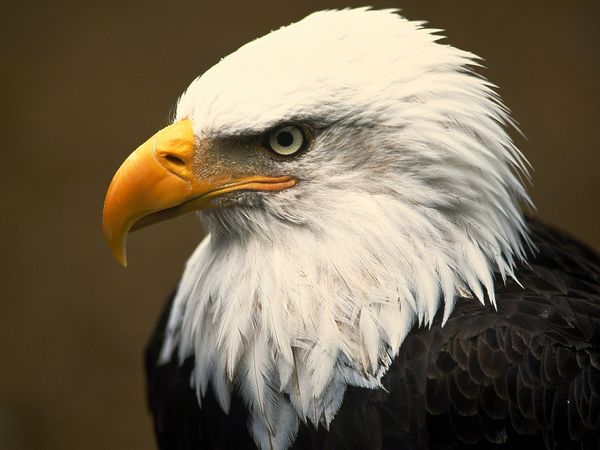
Bald Eagle The air Predator


The Bald Eagle (Haliaeetus leucocephalus Greek hali = salt / sea, aeetus = eagle, leuco = white, cephalis = head) is a bird of prey found in North America. A sea eagle, has two known sub-species and forms a pair with the White-tailed species Eagle (Haliaeetus bid). The rate includes most of Canada and Alaska, across the United States near, and northern Mexico. It is found near large bodies of open water with abundant food supply and old trees for nesting.

The Bald Eagle is a live feed that is opportunistic, especially in fish, which swoops down and snatch from the water with its talons. That builds the largest nest of any North American bird and the largest tree nest ever recorded for each animal species, up to 4 meters (13 feet) deep, 2.5 meters (8.2 feet) wide, and one metric ton (1.1 tons) weight, and achieve sexual maturity at four years or five years.

Bald Eagles are not actually bald, the name is derived from an older meaning of "white headed". Adults are mainly brown with a white head and tail. Gender identical in fur, but females larger than males. Huge beak and crooked. The minor feather brown.

The Bald Eagle is the national bird of the United States and appeared his Seal. At the end of the 20th century was on the verge of extinction on the mainland United States. Populations recover and species was removed from the U.S. federal government list of endangered species on July 12, 1995 and transferred to the list of endangered species. Was removed from the Register of Rare and Threatened Wildlife in the Lower 48 states on the date of June 28, 2007.

The feathers of adult bald eagles over the dark brown with a white head and tail. The tail is quite long and slightly wedge-shaped. Male and female identical in coat color, but clear sexual dimorfisme species females are 25 percent larger than males. Beak, legs and bright yellow Irides. Free leg feathers, and the toes are short and powerful with large talons. Talon greatly expanded from its back legs are used to penetrate the victim's vital areas while being held to move the toes of the front. Huge beak and crooked, with yellow Cere. The adult Bald Eagle is clearly in the area of ​​origin. Closely related African Fish Eagle (H. vocifer) (from far beyond the reach of this Bald Eagle) also has a brown body, white head and tail, but different from the Bald in having a white chest, and a black tip to the bill.

The feather is a minor is coated with dark brown messy white scratches to the fifth (rarely fourth, very rarely third) year, when it reaches sexual maturity. Bald Eagles not produce distinguishable from the Golden Eagle (Aquila chrysaetos), the only one very large, non-greedy birds in North America, in that the former has a larger head and stand out with larger beaks, wings held straight edged flat (not slightly raised) and with a stiff wing beats and feathers are not fully cover the feet. When viewed properly, a special golden eagle feather with a solid color warm brown of adult Bald Eagle, with patches of reddish-gold to the neck and (in adult birds) a set of very contrast of the white box on the wings.

The Bald Eagle is sometimes considered the largest true raptors (accipitrid) in North America. The only larger species of raptor-like bird is a California condor (Gymnogyps californianus), the scavenging birds of the New World at this time is not generally considered as a true ally accipitrids taxonomy. However, the Golden Eagle, an average of 4.18 kg (9.2 pounds) and 63 cm (25 in) long wing chord in American race (A. c. Canadensis), only 455 g (1.00 lb ) lighter in body mass on average and more than bald eagles wing chord length on average by about 3 cm (1.2 in.). In addition, the close cousin Gundul Eagle, White-tailed relative longer but shorter tail winged eagle and Steller Sea Eagle overall larger (H. pelagicus), may rarely vagrate to the coast of Alaska from Asia.
The Bald Eagle has a body length of 70-102 cm (28-40 in). Special wingspan is between 1.8 and 2.3 m (5.9 and 7.5 ft) and a mass is usually between 3 and 6.3 kilograms (6.6 and 14 lb). Females are about 25 percent larger than males, on average 5.6 kg (12 lb), and on the average weight of men 'of 4.1 kg (9.0 lb). Sizes vary depending on location and the birds generally in accordance with the rules Bergmann, because species increased in size further away from the equator and the tropics. The smallest specimens are those from Florida, where an adult male may weigh as little as 2.3 kg (5.1 lb) and has a wingspan of 1.68 m (5.5 ft). Similarly, a small, flat-eagle from South Carolina 3.27 kg (7.2 lb) in mass and 1.88 m (6.2 ft) wingspan. Largest eagle comes from Alaska, where large females may weigh up to 7.5 kg (17 lb) and span 2.44 m (8.0 ft) in the wings. Between linear measurement standard, the chord of the wing is 51.5 to 69 cm (20.3 to 27 in), the tail is 23-37 cm (9.1 to 15 in) long, and Tarsus was 8 to 11 cm (3, 1 to 4.3 in). Culmen reported 3 to 7.5 cm (1.2 to 3.0 in), while the size of the gape to the tip of the bill is 7-9 cm (2.8 to 3.5 in).

Call consists of weak staccato, bird whistles, kleek kik ik ik ik  loom, quite similar to Cadance seagull calls. Calling young birds tend to be more harsh and strident than adults.