Showing posts with label Elephant. Show all posts

Friday, January 11, 2013

Indian Elephant


Indian elephant (Elephas maximus indicus) is one of three recognized subspecies of the Asian elephant, and native mainland Asia. Since 1986, Elephas maximus has been listed as endangered by IUCN as the population has declined at least 50% over the last three generations, estimated at 60-75 years. This species is so threatened by habitat loss, degradation and fragmentation. 

In general, Asian elephants are smaller than African elephants and have the highest body point on the head. Tip of their trunk has one finger-like process. Their back is convex or level. 
Indian elephants reach shoulder height between 2 and 3.5 m (6.6 and 11.5 ft), weigh between 2,000 and 5,000 kg (4,400 and 11,000 lb), and has 19 pairs of ribs. Their color is lighter than maximus with smaller patches of depigmentasi, but darker than sumatranus. Females are usually smaller than males, and have short fangs or not. 

The largest Indian elephant is 3.43 meters (11.3 feet) tall at the shoulder. In 1985, two large elephant cows that I see for the first time in Bardia National Park, and named Raja Gaj and Kanchha. They explore the park together and do the occasional visits to the females. Raja Gaj stood 11.3 ft (3.4 m) high at the shoulder and has a great weight. His performance was compared with a monster because of high bi-domed shaped head. Eyebrows and a more prominent dome of the Asian male elephant. 

Indian elephants have smaller ears, but relatively broader skulls and larger than the African elephant trunk. Toes large and spacious. Unlike their African cousins, their abdomen is proportionate with their weight, but African elephants have a big belly compared to the skull.


Charactheristics of Asian Elephant


Asian or Asian elephant (Elephas maximus) is the only living species of the genus Elephas and distributed in Southeast Asia from India in the west to Borneo in the east. Three subspecies are recognized - Elephas maximus maximus from Sri Lanka, the Indian elephant or E. m. indicus from mainland Asia, and E. m. sumatranus from the island of Sumatra. Asian elephants are the largest land animals that live in Asia.
Since 1986, E. maximus were registered as endangered by IUCN as the population has declined at least 50% for three latest generation, it is estimated 60-75 years. This species is so threatened by pre-loss of habitat, removal and fragmentation. In 2003, the wild population is estimated at between 41,410 and 52,345 people. Female Captive elephants have lived more than 60 years when stored in a seminatural situation, such as forest camp. At the zoo, the elephants die at a much younger age and declining due to low birth and high mortality rates.

In general, Asian elephants are smaller than African elephants and have the highest body point on the head. The back is convex or level. Small ears with folded lateral dorsal border. Have up to 20 pairs of ribs and tail bones 34. Feet have more nail-structure as compared with African elephants - five on each front foot and four on each hind leg.

As is the case with large animals, the dimensions of the Asian elephants are often exaggerated, on average, male shoulder height rarely exceeds 2.7 m (9 ft) and that of female, 2.4 m (8 ft). The average female height is 2.24 m (7.3 ft), and the average weight 2.72 t (3.00 short tons) rarely exceeding 4.16 t (4.59 short tons). Bulls great weight until 5.4 t (6.0 short tons) and 3.2 m (10 feet) at the shoulder. Length of body and head including the trunk is 5.5 to 6.5 m (18-21 ft) with tail 1.2 to 1.5 m (3.9 to 4.9 ft) long. The largest male elephant ever recorded was shot by the Maharajah of Susang Garo Hills in Assam, India, in 1924, weighing 8 tons (8.8 short tons), standing 3.35 m (11 ft) high at the shoulder and 8.06 m (26 , 4 ft) long from head to tail, There are reports from the greater height 3.7 m (12 ft) .

Skin color is usually gray in color, and can be closed by the ground as dust and wallow. Move their wrinkled skin and contains many nerve centers. This is more subtle than African elephants, and can depigmentasi on the trunk, ears, or neck. Epidermis and dermis of the body average 18 mm (0.71 in) thick, the skin on the dorsum is 30 mm (1.2 in) thick providing protection against bites, bumps, and adverse weather conditions. Folds that increase the surface area for heat dissipation. They can live in the cold better than excessive heat. Skin temperature varies from 24 to 32.9 ° C (75 to 91 ° F). Average body temperature is 35.9 ° C (96.6 ° F).


Thursday, January 10, 2013

The African Elephant


African elephant is an elephant of the genus Loxodonta (Greek for 'oblique-sided tooth'), which consists of two extant species: African bush elephant and the African forest elephant is smaller. Loxodonta is one of the two existing genera in Elephantidae family. Although generally believed that the genus was named by Georges Cuvier in 1825, Cuvier spell "Loxodonte". An anonymous writer diromanisasi spelling for "Loxodonta," and the International Code of Zoological nomenclature (ICZN) recognizes this as the right authority.

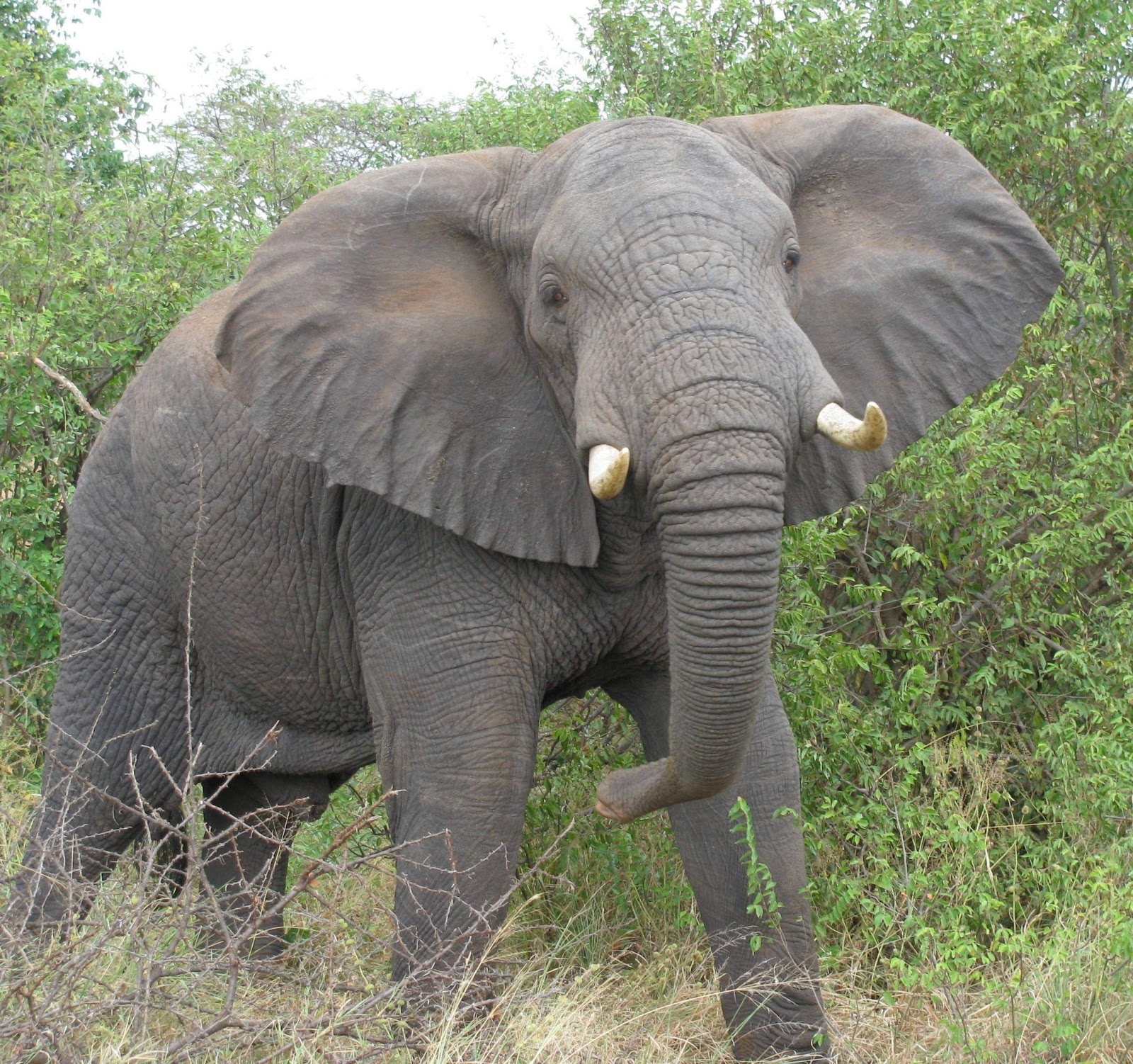
African elephants are the largest living terrestrial animal. Stocky body focused on stumpy legs, and has a concave back. Large ears allow heat loss. Upper lip and nose forming rod. The stem acts as a fifth limb, amplifier and an important method of contact. African elephant's trunk ends in two lips to the contrary, while the Asian elephant's trunk ends in a single lip. African bush elephant is larger than Asian elephants. Men stand 3.2 to 4.0 m (10-13 ft) high at the shoulder and weigh from 4.700 to 6.048 kg (10.360 to 13.330 lb), while females stand 2.2 to 2.6 m (7-9 ft) high and weight from 2.160 to 3.232 kg (4.762 to 7.125 lb).
Largest individual recorded stood four meters (13.1 feet) to the shoulder and weighs 10 tonnes (10 long tons, 11 short tons).

Elephants have four molars, each weighing about 5 kg (11 lb) and measure about 30 cm (12 in) long. As the front pair wear down and point out the cuts, the couple returned to shift forward and two new molars emerge in the back of the mouth. Elephants replace teeth six times. At around 40 to 60 years, the elephant no longer has teeth and will likely die of starvation, a common cause of death.

Their canine teeth of the company, the second set of incisors become ivory. They used to dig roots and stripping bark from trees for food, for fighting each other during mating season, and to defend themselves against predators. Ivory weight 23-45 kg (51-99 lb) and can be 1.5 to 2.4 m (5-8 ft) long. Unlike Asian elephants, both male African elephant and girls have fangs. They are curved forward and continue to grow throughout the elephant's life. Molar enamel accent a little more volume than Asian elephants.